Some families like the Barkers and the Bakers lived in the same property for over one hundred years and many residents and their descendant families have lived in the Road for over fifty years.
These include Yokiel (1945-2018) at no. 10,
Bailey (1939 – 1990’s) at no. 12,
Farr (1909 – 1964) at 11,
Bridger (1919 – 1969) at 15,
Collinson (1950 – 2010’s) at 16,
Peterson (1952 – 2010’s) at 18,
Young (1959 – 2010’s) at 23,
Barker (1922-2022) at 24,
Baker (1910 – 2010’s),
Bridges/Hawkes (1929 – 1988),
Monger (1945 – 2010’s) at 30,
May (1939 – 2010’s) at 32,
Fry (1938-1997) at 34,
Rowlands at 39,
Dawson at 42,
Davies (1961 – present) at 44,
Baldwin (1951 – 2018) at 62,
Bonner (1937 – 1980’s) at 68,
Childs (1946 – 2004) at 51/53,
Mitchell (1957 – 1998) at 55
Godwin (1976 – 2026) at 3
Here are the stories of some of the families
Baker
George E Baker and his wife Mary ran pub at Blackheath near Wonersh. Mary apparently ‘took to the bottle’ and they decided to move to Yew Tree Road. They bought several plots on which 37/39, 35 & 46 would be built. They built The Pines (37/39) in 1909/10.
Their son, Edward G Baker (Ted) emigrated to Canada in 1911 but came back to join the Queens Regiment and fight in First World War. He received a head injury and was made a prisoner of war from 1915 to 1918. On his return, George and Ted built the original El-Arish (46) on Plot 25 allegedly using some materials from the Canadian camp on Witley common. El-Arish was named for the location (now on the border between Egypt and Israel) where his brother was killed in the War.
George & Mary continued to live at The Pines and Ted at El-Arish until 1926 when they all lived at 2 The Pines (37). From 1927, they rented out 1 The Pines (39) to Alice & George Rowlands at the princely sum of £1.92 per week. Ted moved back to El-Arish in 1939 where he eventually married Maisie Mullard having been prevented by his grandmother until she died as she objected to the fact that they were cousins.
When the Yew Tree Road was made up in 1956, the family was faced with a large bill as the owner of property frontages in the road. To pay the charges, they sold a property in Chiddingfold.
Ted & Maisie moved back to The Pines in 1962 after his father George had died. He sold El-Arish to cousin, Eric Mullard, but put a covenant on the property that it could never be called by that name. At the same time, they sold the plot adjacent to The Pines on which number 35 was built by George Newman of Oxted Green. The land had previously been cultivated by Ted as a vegetable plot and over which he allowed children to go through to play in the woods. Ted was a Labourer with the Mid-Southern Electric Company was reputed to know all the holes in the Godalming area. He was a founder member of the Witley MotorCycle Club. Apparently, at one stage, he had a wild ginger cat. Maysie worked initially at the Guildford Post Office in the Upper High Street and then worked at Witley Post Office for some years.
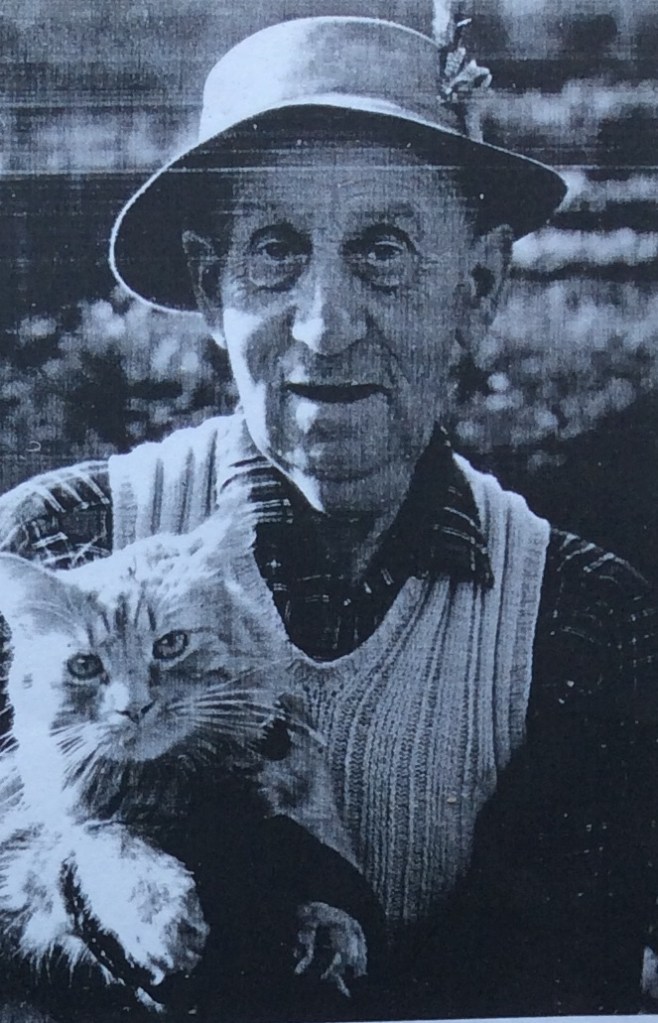
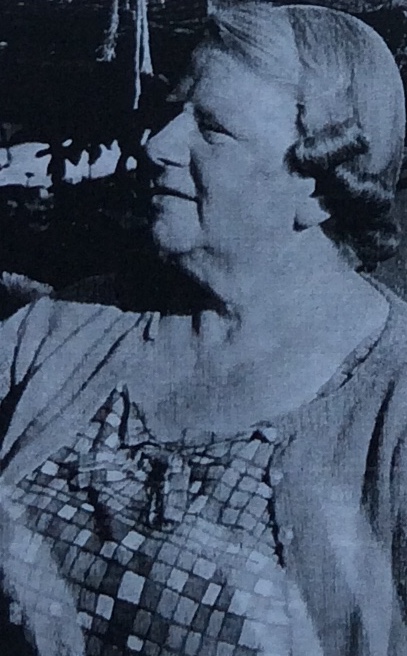
Maysie died in 1977 and Ted went into a Care Home where he died in 1979. The Pines was acquired by Bernard and Margaret Everett. George Baker was Bernard’s great uncle and Ted Baker had married Bernard’s mother’s sister. In 1984, their daughter Shirley and her husband Peter Harvey sold their house in Guildford, acquired the property from them and came to live in 39. Their daughter, Kate, was two years old at the time. They eventually sold in 2010s.
So through George and Ted and Bernard and Shirley, the Bakers and their descendants had lived in the house for over a century.
Dawson
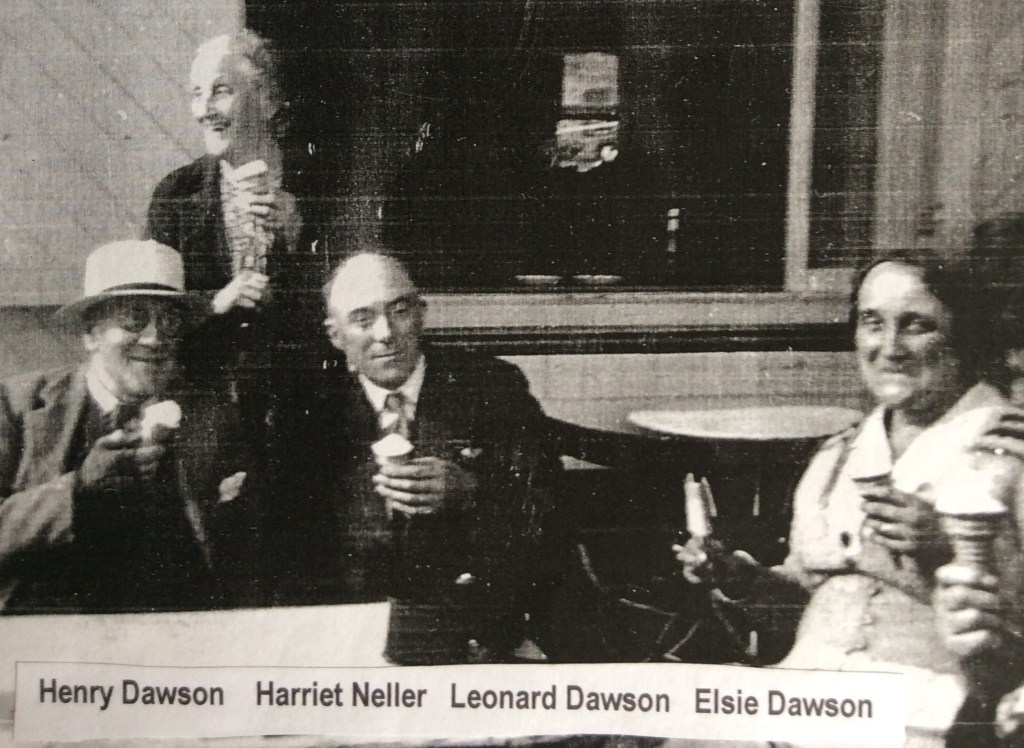
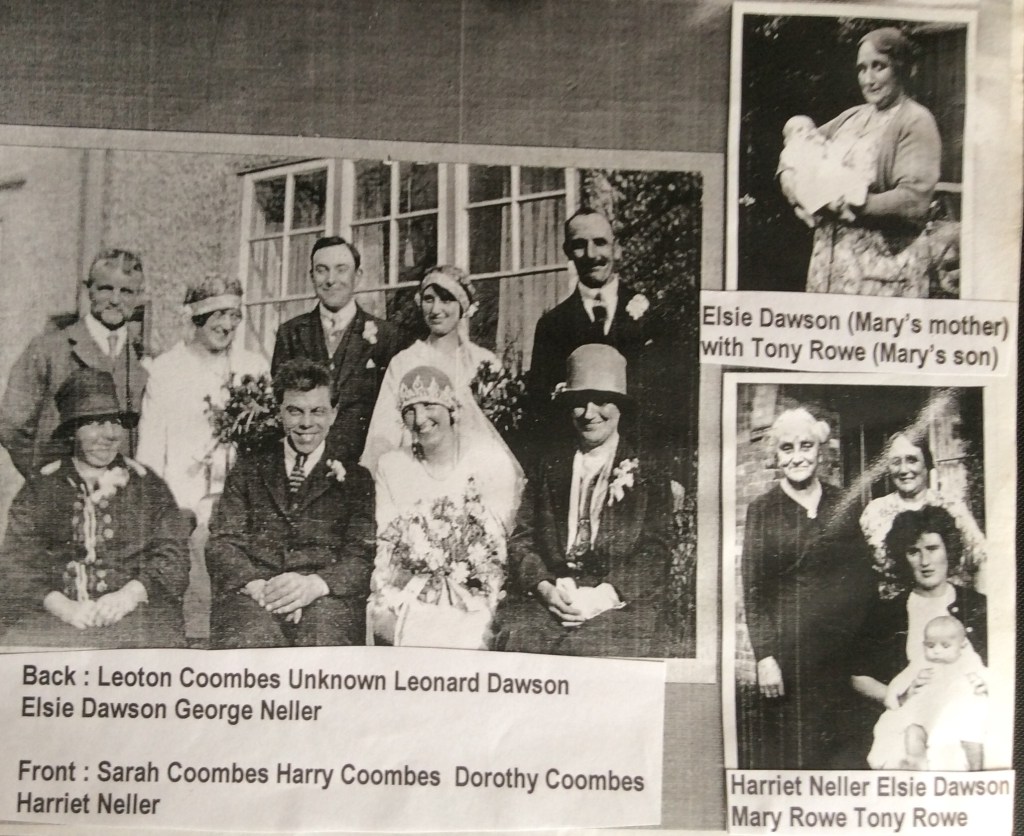
Mary Rowe nee Dawson lived nearly all of her life in this road. Her family have lived in various house in the road starting in the 1920’s.
Her father and mother, Leonard and Elsie Dawson, bought Cornholme (number 42) in 1931 where Mary was born.
Mary’s aunt and uncle, Henry and Dorothy Coombes, lived next door at Holmlea (Number 44) at the same time and Mary’s grandmother, Harriet Neller, also lived there at some time.
The parents of Henry and Dorothy Coombes were Leoton and Sarah Coombes and they lived at Cyprus (Number 14) from 1926.
Mary’s grandparents, Henry and Caroline Dawson, lived at The Yews (number 45) from 1938
Mary’s uncle, Fred Neller, built The Yews, Heath Cottage (Number 38) and Fernden Cottage (Number 40) from the same design in the late 1930’s.
Mary’s younger brother, John Dawson, lived at Number 36 in the 1960’s.
Mary remembered playing on Tanners Field which eventually became numbers 47 to 59.
The original Yew Tree was at The Yews but was cut down in the 1970’s. See the story under LAST.
A family with 90 years of residence.
Mary died in January 2021.
Barker
The Barker Family have lived in the road since the 1920’s.
William Barker bought Waverley (number 26) in 1921. The property had been built before 1910 and had been requisitioned by the Canadians during the First World War when they occupied Witley Common as a camp. Part of the property may have been used as a laundry but more likely it was occupied by a senior officer.
William was married to Margaret and they had six daughters – Joan, Elsie, Margaret, Marion, Dorothy and Hilda. Except for Joan, they were all born at Waverley.

William Barker was a builder and he constructed several properties in the road between 1936 and 1939. These were Oakhanger (number 16) named after his yard location, Willmar (number 18) named after William and Margaret, Farleigh (number ), Wingrove (number 10) which was Margaret’s maiden name, Dawney (number 8) named after Dawney Bottom and Ano (number 28) which was originally Waverley Stores.
The houses were initially rented out but he gave them to his daughters as they became married. Wingrove became the home of Elsie who married Bill Jokiel. Oakhanger became the home of Dorothy who married Roy Collinson. Waverley became the home of Hilda who married Peter Millard.
Both Hilda and Dorothy remember playing on Tanner’s field (where numbers 47 to 61 were built). Apparently, it was owned by Mr. Tanner who lived in Cramhurst Lane.
William Barker built Waverley Stores was built as a shop with living accommodation and rented out.
Another family with a century in this road.
Monger
These are some memories of John and Elsie Monger’s daughter, June who was brought up at Velhurst (number 30)


NOTE – Keith Stay says that Mr. Luckett’s name was John aka Jack and that he gave up the shop in 1968/9 when it was taken over by his mother Hazel and her children were named Carole and Keith (not Kevin).
NOTE – Malcolm Collinson says that it was his mother, Dorothy (not Marion), who worked in the shop every Saturday afternoon and that Mr. & Mrs. Sargent bought the shop in 1971 and it was he (Malcolm) who married their daughter Diane in 1974 before moving to Farnham.
Davies
These are the memories and family history of Colin Davies.
My mother’s National Identity Card shows our family moved to Yew Tree Road on 30 August 1949.
The family came from Wood Green in North London. My grandparents were Bob and Mabel Bodley. Bob was a carpenter and joiner who, after his discharge from the army at the end of World War I, travelled across the country with his work, and Mabel would travel with him. In 1922, Bob worked in Milford, while he and Mable lived in Witley, at Myrtle Cottages, in Wheeler Lane, near to The Star.
They returned to live in Wood Green, and remained there until early in World War II, when Bob and Mabel, together with their daughters Marjorie, my mother, who later joined the WAAF, and Jean, moved to Chiddingfold. Mabel’s brother was living in the area and had been able to find them work.
After the war Bob and Mabel, together with Marjorie, who was discharged from the WAAF in 1946, and Jean, remained in Chiddingfold, before moving to Witley in 1949, firstly to Sunnydown, and then to 6 Yew Tree Road (now 58).
Bob worked for King and Taylor, a coachbuilder in Godalming, before getting a job at Milford Chest Hospital. Marjorie worked as a bookkeeper, while Jean trained at Haslemere and Guildford Hospitals to be a State Registered Nurse.
In 1957, Marjorie married Eddie Davies, an engineering worker, and former coal miner, whose family lived in Guildford, but were originally from the Rhondda Valley in South Wales. Eddie came to live with Marjorie and the family at 6 Yew Tree Road.
In 1960, Eddie and Marjorie moved to Holmlea (44), which was built about 1930 by Harry Coombes, who had lived there ever since with his wife Dorothy. Eddie also knew Mr Coombes from Godalming Band, where they were both members. Mr Coombes was a founder member of the band, in 1937, and later became the band’s president.
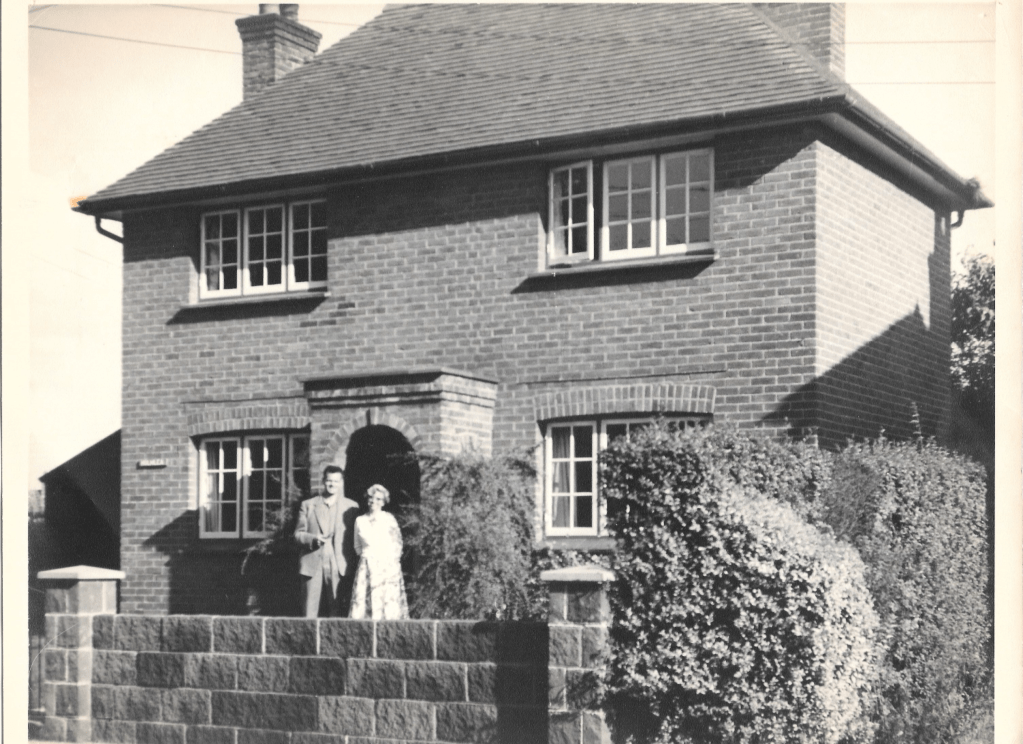
The building plot for Holmlea originally ran from Yew Tree Road to Cramhurst Lane. Mr Coombes recalled that, when building the house, he made the stairs in a shed in the garden (which still exists), but then he could not get them out of the shed door.
In the late 1950s, Mr Coombes divided the plot into two and built a new house on the Cramhurst Lane half. When they sold Holmlea, Mr and Mrs Coombes then moved into their new house in Cramhurst Lane, and they remained living there for many years.
My grandparents Bob and Mabel continued to live at 6 Yew Tree Road (now 58) until the mid-1960s, when they moved to flats, then recently built, in Roke Lane facing the entrance to Middlemarch. My Aunt Jean had already moved away to continue her nursing career.
In the 1960s, Eddie and Marjorie had me, and then my brother, Gavin, and we have lived at Holmlea ever since. Holmlea was modernised and extended in 1972/73, and then renovated in 2019/20. The building work at Holmlea in the early 1970s was carried-out by Dave White, who lived next door, at 46. At about the same time, he enlarged his own house, giving it the twin gable ends it has today.
In the 1960s, and into the 1970s, Yew Tree Road seemed to have less traffic than today, but a lot more pedestrian activity. In particular, people walking to and from the shop, Waverley Stores, at 28. It was a grocer’s shop that, despite its small size, seemed to sell all the grocery items you could need. At the front was a large window, and the entrance was to the right of that.
As you went inside, facing you was the counter across the width of the shop, whilst behind you, under the window, was a freezer. At the back of the shop, behind the counter, was a store room. In the shop there were packets, tins and bottles, plus frozen items, and large jars of sweets, such as flying saucers.
Waverley Stores had a number of different owners over the years, but it ceased to be a viable business and was converted to residential use in the mid-1970s.
The other retail premises in the road was a single-story building, a former green grocer’s shop, on the site of what is now Wey House. It became a ladies’ hairdressers in the 1960s and early 1970s. I remember my mother taking me there when I was very young. In the late 1970s / early 1980s it was a shop selling craft-made decorative items. The building was then replaced.
In the 1960s, a large van, which customers could walk into the back of, regularly visited the road and provided a mobile general grocery service. In the late 1970s / early 1980s, there was, for a time, another mobile retail service, this time for green grocery items.
Hammond’s Bakery, in Milford, had delivery rounds on a Tuesday, Thursday and Saturday, until they closed in about 1997. For many years, the delivery man was a Mr Bun, who lived in Gasden Copse. After he retired, his long-term replacement was a man called Bobby. They drove a green delivery van, and carried the items from that to their customers in a large wicker basket.
There were two daily milk rounds serving the road. One provided by Stovold’s Dairy, in Godalming, and the other by the Co-op. For some years, the Stovold’s milkman was a genial Scotsman, known, appropriately, as Jock, who would often carry-out errands for his elderly customers, which included giving them a lift from the bus stop on his milk float. Stovold’s milk round ended in the 2000s.
In the late 1960s / early 1970s a regular sight in the road was Ted Baker, who lived at The Pines, with his big, ginger, feral cat. He would take that for a walk on a collar and lead, just like he was taking a dog for a walk. (I seem to remember he had to wear gloves to handle the cat, as it was so wild.)
When the National Trust Centre on Witley Common opened, in 1976, it had an automated slide show, which featured photographs of Ted Baker, and a soundtrack on which he talked about how he would, when he was much younger, help to look after the livestock that was then kept on the common.
The common was an excellent place to play and explore at weekends or during the school holidays. In the late 1970s, in my holidays I would help the National Trust warden by clearing unwanted growth. I associated summer holidays with the road being resurfaced. It seemed that every year – on the hottest day of summer – council workers would put down a new layer of tar and chippings on the road.
I started school in the 1960s, and, like other children in the road then, I went to Milford Infants School first, and then to Milford Junior School, next to Milford Church. By the time Gavin started school, in the 1970s, Milford Juniors was closed, and had been replaced by Chandler Middle School, in Witley. After that, we both went to Rodborough School. I started there at 11, while Gavin started at 12.
In the summer of 1977, for the Queen’s Silver Jubilee, there was a street party for the children, Tables and chairs were set-up in the road for the refreshments, and afterwards there were games, with sweets given as prizes. All the children attending were also given a commemorative Silver Jubilee Crown.
It was held in the street outside Holmlea. Eddie had a large radiogram, with powerful speakers. He put the speakers in the front garden and played a variety of music provided by people in the road. During the refreshments, residents provided entertainment, such as playing the spoons or the mouth-organ.
It is over 70 years since my family first moved to Yew Tree Road. My brother, Gavin, and I continue to live here. The road has evolved, but it has retained its essential character as a pleasant place to live.
Childs
Susan Childs is the daughter of Alfred Childs who built the properties (no’s. ) immediately after the Second World War – see POST. She was born at Ohashi in 1948 and her brother Nicholas was born there in 1950. The family moved to Enton Green but came back again in the 1950’s when her father had finished building Little Brackens (41) where lived for many years.
This picture shows Susan and her friends in the garden of Little Brackens. From left to right are Heather Hilkemier, Susan Childs and Julie Sharp with June Monger in the front.

The family then moved to Merry Down (53).
Susan’s memories are playing with her friends featuring dolls and skipping and hopscotch in the road. She remembers the freedom of playing games and climbing trees on the common at the back of the house.
Susan worked at Chandler school kitchen for 32 years before retiring in 2007.
Hilkemeier
Heather Dunford grew up on Yew Tree Road as Heather Hilkemeier.
I remember as a 6 year-old, watching Alf Childs build Little Brackens. His daughter Susan and I met at that time and have been best friends to this day.
In 1964 my family moved in to Ano, which was a flat behind and over Mr. Barkers store and next door to your contributor June Monger. We lived there for 4 years and then moved in to another of Mr. Barker’s properties, Waverly Southside. This was a flat in part of Mr. Barker’s own house. So we had the Barker’s on one side as neighbours and the Harold and Doris Burgess family on the other. My Dad was an ex American GI and Harold was a ex Canadian soldier from WWII. Obviously, they both fell in love with pretty English girls during the war.
Susan Black (nee Childs) already posted a picture of us in the road with our dollies. I am the girl on the left in the picture. We girls played a lot together with our dollies, two-ball, hopscotch, jump rope etc. but we also played a lot with the boys – mostly on the common. As innocent as we look in the photo – I can assure you we got up to a lot of mischief. I can even remember us being out on the common with tennis rackets. We would hit stones with our rackets toward the back gardens and listen for the sound of breaking glass. Always hoping our missile would find it’s way to a pane of glass in a greenhouse! I cannot imagine a better childhood. Not perfect of course because life happened but very, very happy most of the time.
Garnish
Wendy Chapman grew up in the road as Wendy ((Gwendoline) Garnish at 2 Yew Tree Cottages (now number 66) – these are her memories:
I was born at 2 yew tree road (the council houses) and lived there with my mum Lena Garnish, my big sister Pat ,then Christine, me Wendy, then Pauline. My mums sister auntie em Kelly and Patsy her daughter lived with us. 7 females, it was wonderful.
The road was all bumpy and sandy with potholes and puddles and a few dogs used to roam around. Everything was friendly and we all knew each other. We used to play round the green thing ….as we called it…a big green box on the corner of the road with electrics or something inside and play hopscotch or go over the Common behind the houses to play we all went together.
I can’t tell you what fun it was living in yew tree road as a kid. We had no money but so much love from everyone and so many friends – the Baldwins, the Chittys, Sue Childs, Julie Sharp, Linda May, Iris winter, all of the Bridgers, Beryl Enticnap, and the Forths who lived one side of us and the Bonners the other side. All the parents were nice too we all helped each other.
We used to have a rag and bone man come round. We gave him clothes and he gave us a goldfish in a plastic bag. We thought it was wonderful. After the war a army lorry would drive slowly up the road giving out to us children 3 cakes in a paper bag from the back of the lorry ,a true luxury to us. We went to Milford school then on to Rodborough school on the Common. We all walked whatever the weather, thick snow storms whatever, and no mums or anyone taking us.It was just done, not many cars around then
As children ,we all went to sunday school every week but mainly because we went round to one of the preachers wife’s house afterwards for tea, very special, cakes, sandwiches all a treat for us. We called the preachers uncle Bob and uncle eric and auntie vi who was one of their wife’s, the house we had tea in. Dot and Joy bonner who lived next door came too.
Halfway up the road lived Mr and Mrs Dawson…and they had a black and white television, none of us others had a t v so whenever Roy Rodgers, the cowboy of the time was on, a whole group of us kids used to line up and go in to watch it. Some sat on the table, some under the table, anywhere we could. When it was over we would file out and Mrs Dawson would stand at the door and give us a few dolly mixtures twisted up in a bit of white paper. So sweet of her and it meant so much to us kids because sweets were a real treat.
Mr Forth, the shop owner, who lived next door used to race pigeons, if they came home really late he used to wring their necks and throw them over the wall so mum could make a pie with them. I had a pet rabbit and came home from school and was going to feed it but mum said have this nice chicken stew first. So I did only to find out later I had just eaten him….that’s how it was then but you couldn’t be fussy them days.
We had no central heating and so we had a old round black paraffin stove. At night we would sit round it in a circle in the dark and plug the wireless in the light on the ceiling and listen to stories on the radio. Sometimes, they were scary stories and we would all hold hands but we all enjoyed it. We all had each other.
By the way the army had little camps on the Common behind the houses and some of us used to pinch their veggies that they grew in the gardens in front of their camps, especially carrots which we just rubbed clean and ate while running home.That in them days was the naughtiest thing we did !
Hoovers weren’t around then. We had a hoover salesman knock on the door and offered to show mum how it works. So he hoovered a bit of floor and we were amazed he did the housework. By the time he left he had nearly hoovered the whole house and mum was well pleased she had pretended she didn’t understand the workings of it. She could never afford to buy one. So he was out of luck.
We also had a man come round with a catalogue. Hugh Whylie catalogue. They had a shop in Guildford at the time. Mum used to buy our clothes on tick….paying a bit at a time. It was that and jumble sale clothes which were passed down from sister to sister as we grew out of them. We survived.
As we got older, we didn’t have telephones so if we needed to let our mum know something important we would phone Mr Bakers and later Mr Locket’s shop and he would pop down and tell our mum.
I lived at number 2 until I got married 58 years (ago in 1965). My husband and I bought Wenick (now number 9) the house at the top of the road by Mr Farr (at Firglen). It was opposite Mr. Forth’s shop and we named the house Wenick ….our names are…Wendy and Mick.
Life was hard but simple and we just got on with it. Yew Tree Road was a real home and the residents so friendly and happy, but we nearly all had nothing.

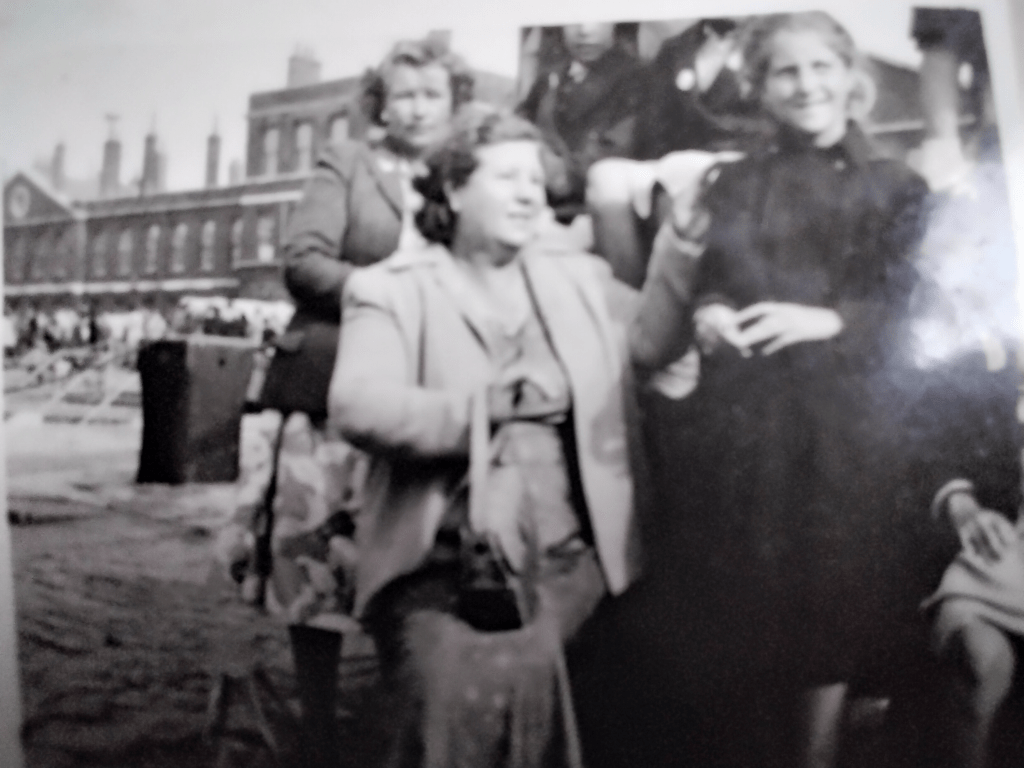
Wendy with her mother Lena and Auntie Em (at the back)
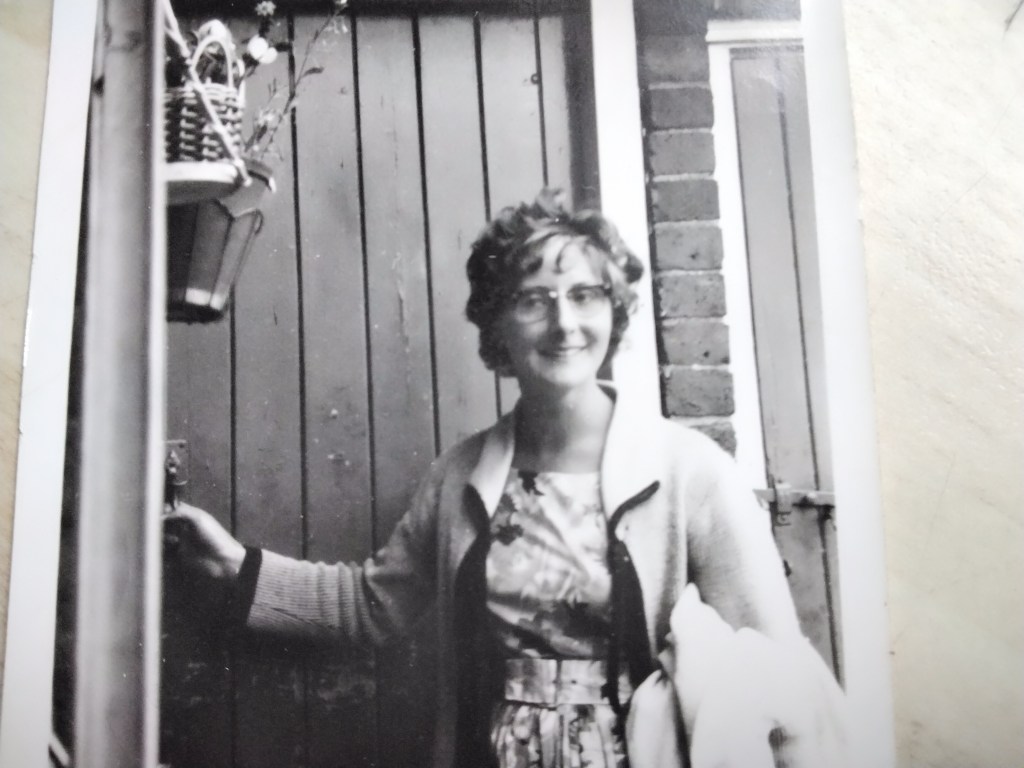
Wendy’s sister Pat
 Yew Tree Road Witley History