This an aerial photograph of the road in 1947. It shows the extent of the residential development and, looking very closely, the poor state of the road.

THE CHILDS DEVELOPMENT
There had been no development during the Second World War, but immediately Alfred Childs built on the land where the VE Day party had been held.
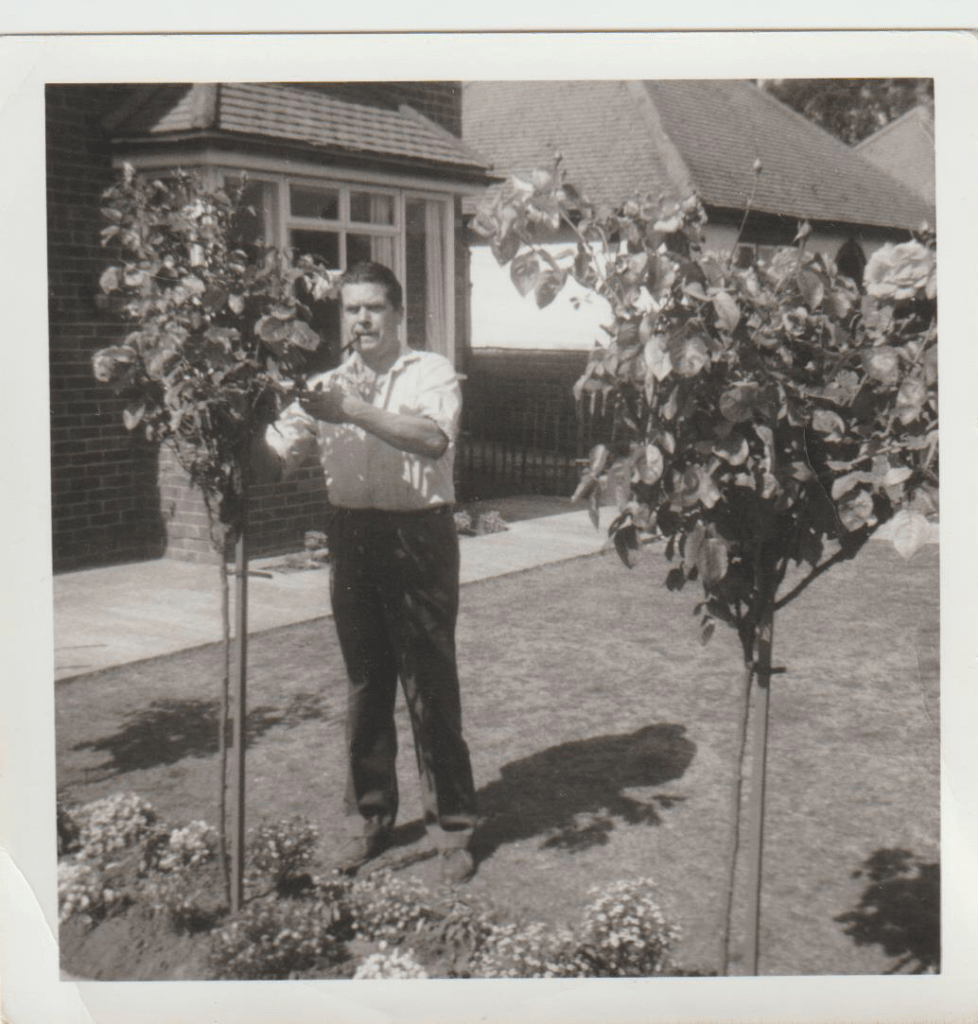
He had been brought up by his mother and step-father (Charles Richardson) after his own father was killed in the First World War when Alfred was only two years old. He joined his step-father who had his own business in Farncombe in building houses in Farncombe, Godalming, Witley & Wormley. They intended to buy and renovate old houses but the Second World War intervened. Alfred Childs became a prisoner of war in Japan for three and a half years.
He constructed four houses namely Newland, Strathelyde (later Willson), Ohasi and Merry Down (Numbers 47 to 53). The aerial photograph shows their existence and the Electoral Registers confirm residents occupation in 1946 and 1947.


All of the properties have subsequently been extended.
Little Brackens (41) was built in about 1955/6 by Alfred Childs in his spare time with the help of his brother.

SEWERAGE
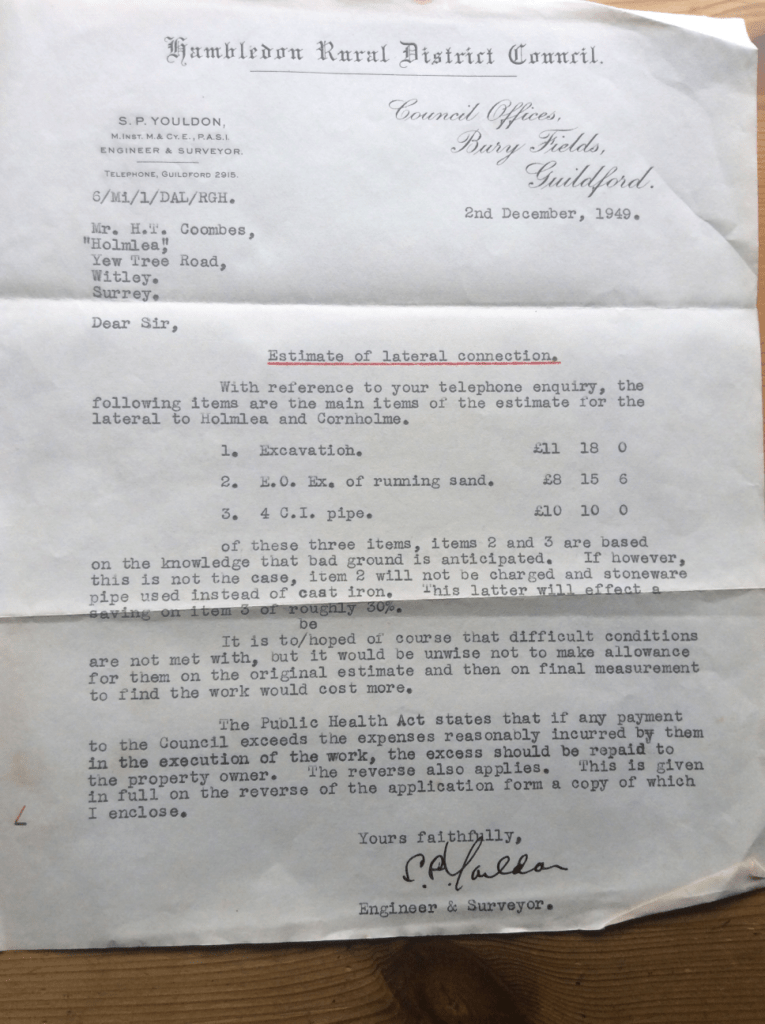
The main sewer was constructed in 1949/50 and a great relief to all residents.
This a typical letter sent to owners setting out the costs of connecting lateral pipes.
MAKING UP THE ROAD
The road was originally scheduled to be made up in 1940 but the War intervened and it was not until 1956 that it was properly constructed. Previously it had been little more than a track with huge puddles after any rain. Many residents remember the difficulty of using the ‘road’ in wet weather. The owners of the properties fronting the road had to pay the cost of making up the road under the Private Street Works legislation.
HOUSE NAMES
Street numbering of the road did not occur until 1968. So all houses required a name at the choice of their occupant or owner. It appears that most houses were named as soon as they were built. Probably the first names were Stoatley and Oakhurst (23 & 25) as their names are painted above their front doors.. At this time, Ledwer and Werled (29 & 31) were obviously named as a pair by the original owner andFirglen (11 & 15) has its name incorporated into the brickwork near the roof. Both Firglen and The Pines (37 & 39) were clearly named after the view of the adjacent woods.
Between the Wars, INTER highlights how El-Arish (46) was named by Ted Baker in honour of his brother and how Dawney (8), Wingrove (10), Oakhanger (16) and Willmar (18) were named by William Barker. The Yews(45) is obviously where the original Yew Tree was sited. Velhurst (30) was named after the original location of Elsie Monger’s family and Shrewsbury (32) named after the origin of ‘Ting’ May’s family. Other names at this time were more traditional like Cornholme (42) and Holmelea (44).The only numbers before the official street numbering was by the Council which called its development Yew Tree Cottages 1 to 10 starting from the house on the corner (68).
After the Second World War, the Child’s development produced a set of names – Newland (47) which is a bit obvious, Strathclyde (49) which eventually became Will-son in 1956 when a Mr. Parsons named it for himself and his son, Ohashi (51) which is named after the Japanese POW camp where Alfred Child’s was held and Merry Down (53). The Bungalow (55) was originally named 1 The Bungalow and the Eltham Cottage. There was confusion between the two original bungalows (57 & 63) with both starting out as 2 The Bungalow before Alderney (63) became a name.
In the 1960’s and 70’s, new properties brought new names. Staveley (1), Quiso (5), Wenick (9), Chippings (19), Como (21), Cedars(27) and Wharton (35) have all featured. Wenick was named after Wendy & Mick Chapman. After official street numbering in 1968, a few names have remained on display.
There are some houses which have had their names changed like Maple House (originally Strathclyde, then Will-son), Woodland View (originally Ohashi) and Dialstone Cottage (originally Fernden Cottage).
.
LATER DEVELOPMENTS
Plots continued to be developed. Numbers 1, 7 & 9 and 19 & 21, 27 and 35 were built in the 1960s and 59 & 61 were built in 1970’s.
 Yew Tree Road Witley History