GEORGE TICKNER
George Tickner bid £1510 for the lots for at the auction in Godalming. He paid a deposit of £151 on the day. The land was eventually conveyed to him by Sir William Marling on 26 January 1906 when George Tickner paid the balance of £1359. Local Solicitor (and part of a local banking family), R.H. Mellersh had loaned him £1547 with interest at 4.5% payable half-yearly.
George Tickner lived at Chapel Road Milford and was a local builder with a yard in Godalming. He had been born in Godalming on 13 June 1830 at Hart’s Lane (now Mint Street). It seems that he was orphaned at an early age and was taken in by relatives to live at High Eashing. His trade was carpentry but eventually became a builder.

His intention was to develop the land as a residential road. Around the turn of the Century, there had been some houses built in Milford and more immediately in Khartoum Road and along Cramhurst Lane and he thought that this was a good location.
ROAD LAYOUT
George Tickner set out his road by following the south-eastern edge of field parcel 358 shown on the 1897 map from Gasden Lane, then looping the road around the clump of trees in the corner of the field before turning to join Cramhurst Lane near to the existing properties. The trees must have been a significant site and an obvious name for the road. The clump included oak and yew trees. Yew Tree Road thus acquired its name. Two oaks still remain together with the stump of a yew tree (in the front garden of The Yews – number 45).
The land on either side was divided into single plots for purchase and development of single houses or semi-detached properties. There were also plots fronting Gasden Lane and Cramhurst Lane.
In the Spring of 1906, George Tickner laid out the boundaries of the road and staked out the individual plots. He installed a water supply. He had a plan prepared which showed 49 plots for building houses.
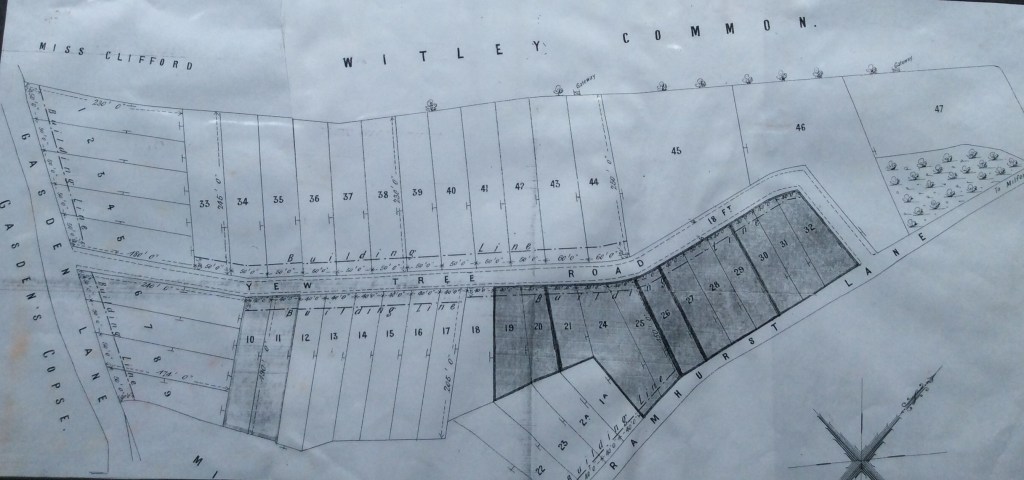
He advertised the plots for sale by auction at the White Lion Inn in Milford at 6 p.m. on Friday 18 May 1906.
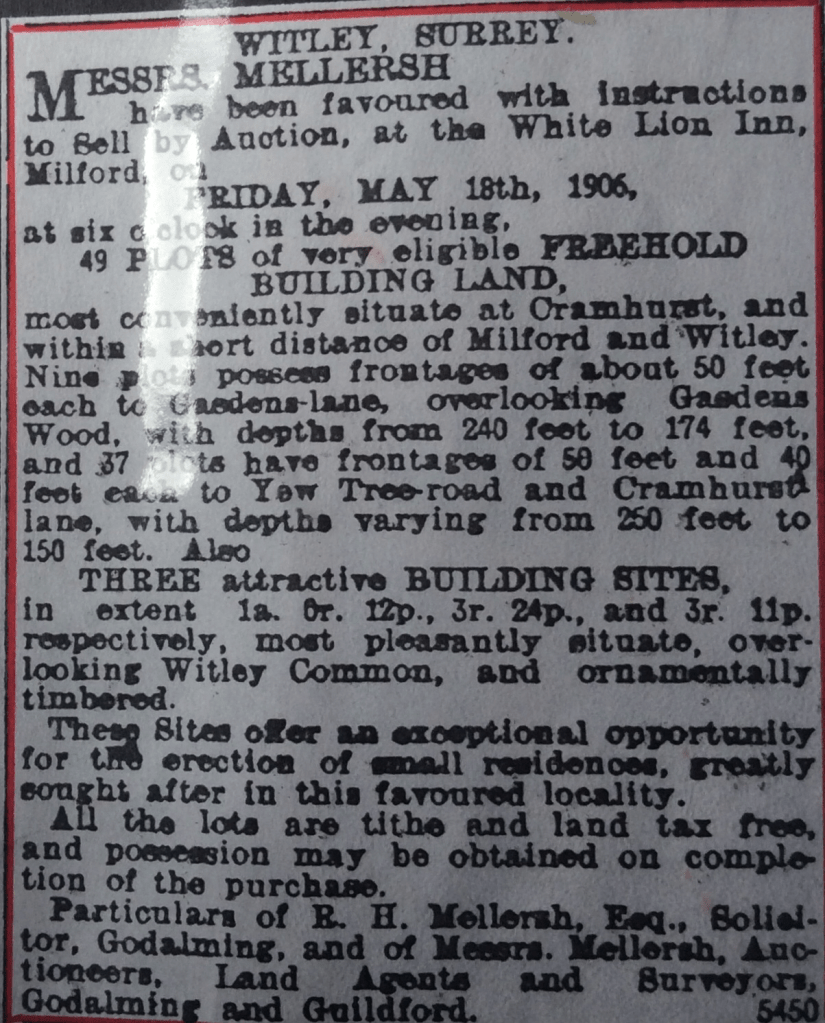
COVENANTS

Each sale contained covenants designed to maintain the standards of the road. The covenants were standard in estate layouts. These were the days before planning legislation when covenants were designed to protect the estate seller (from unsuitable development as he had remaining plots to sell) and the purchaser (from unsuitable development in the road). Houses were to be of a particular standard (given in value) with the frontage protected by a building line. Note the reference to ‘outhouses’ – there were no inside lavatories. The road was unmade and each purchaser took on the responsibility for its future maintenance.
MELLERSH
The Mellersh family were local estate agents (and auctioneers), Solicitors and Bankers. They financed George Tickner in his purchase of the land, they arranged for the sale of the individual plots and, in some instances, financed the purchasers of individual plots. They were highly instrumental in the creation of the road.
 Yew Tree Road Witley History